Refuse bad packages on the install path
Vulnerability, license and version rules plus 25 supply-chain signals beyond CVE run before a package enters a build. Depth varies by ecosystem.
For AppSec
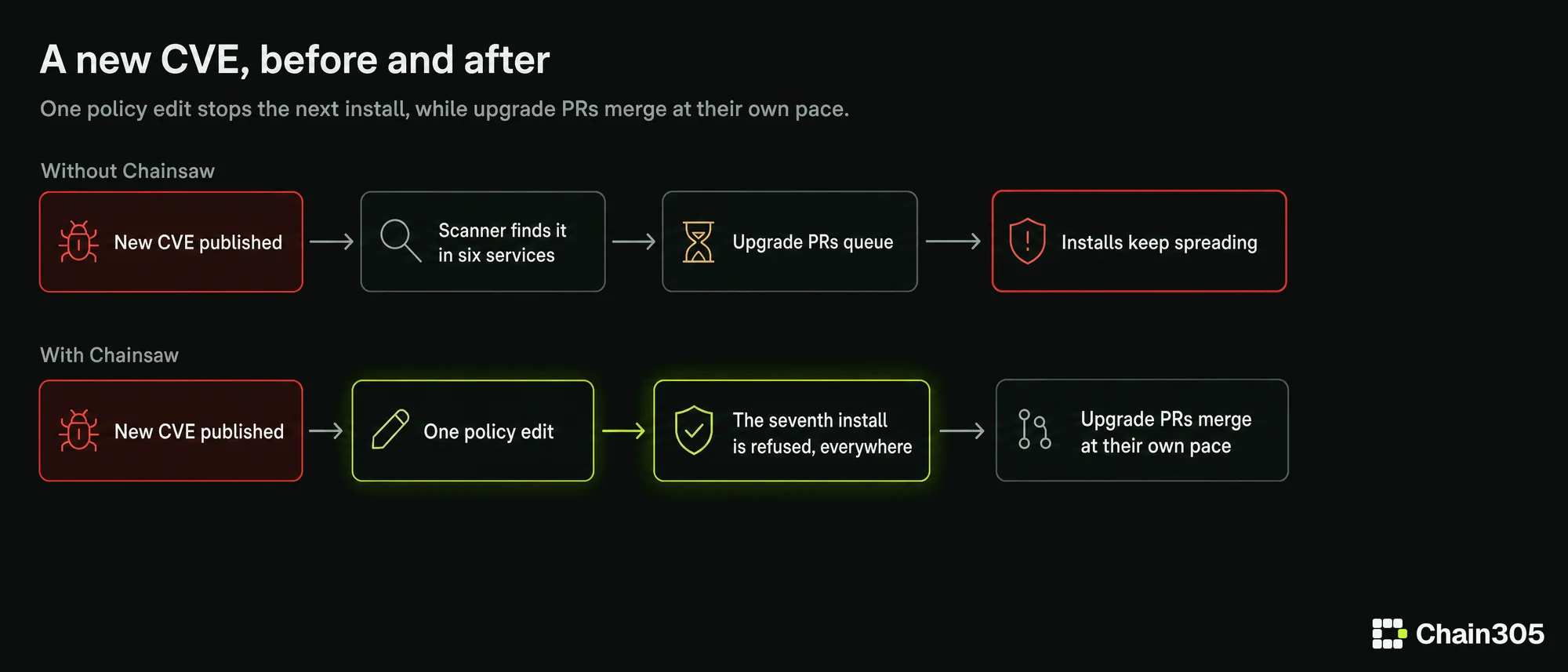
Push one policy edit and the affected version stops installing in every repo, CI job and laptop. A scanner finds log4j after it's in six services; Chainsaw refuses it on the seventh.

The pain
What changes
Vulnerability, license and version rules plus 25 supply-chain signals beyond CVE run before a package enters a build. Depth varies by ecosystem.
One policy edit rolls out in minutes, with no upgrade PR needed to halt new spread.
The refusal names the rule, the reason and who owns the exception path.
Zero-disruption rollout
01
Point package managers at Chainsaw
One registry line per package manager. No build-script changes, no laptop agent.
02
Start in monitor mode
See what your rules would have blocked across every repo, with no build broken.
03
Flip to enforcement
Per-policy toggle. Enforce the rules you trust; keep the rest in monitor.
Questions AppSec teams ask
AppSec teams block malicious packages before install by putting a package firewall on the install path, so a refused package never reaches a laptop or a build. Chainsaw is that firewall for 17 package ecosystems, including npm, PyPI, Maven, Go modules, Cargo and Docker. Each package manager gets one registry URL that points at the Chainsaw proxy. On every request, Chainsaw checks the package against a known-malicious feed and 25 supply-chain signals beyond CVE, such as typosquat matching, install-script exfiltration and maintainer-account takeover. Signal depth varies by ecosystem. By default, new npm and PyPI versions are held for 48 hours, and packages first published less than a day ago are refused. A refused install gets an HTTP 403 that names the rule and the exception owner, and the decision is written to the audit log. Every rule can run in monitor mode first, so the team sees what would have been refused before enforcing anything.
AppSec can stop a new CVE from spreading by refusing the affected versions at install time, which halts new spread while upgrade PRs are still in review. Chainsaw evaluates vulnerability rules on every install request, using CVE, CVSS, EPSS and the CISA Known Exploited Vulnerabilities (KEV) catalog. EPSS, published by FIRST, estimates the probability that a published CVE will be exploited in the wild in the next 30 days. A rule can combine those inputs, for example refusing versions with a high CVSS score that also appear in KEV. One policy edit applies to every repository, CI job and laptop that installs through the Chainsaw proxy. Chainsaw's inventory answers which projects already include the affected version, and patch-priority ranking orders the fixes by KEV and EPSS. Opening and merging the upgrade PRs stays with Renovate or Dependabot. The rule can run in monitor mode first to measure how many builds it would stop.
Chain305 tested public 2026 supply-chain attacks against production Chainsaw (v0.22.127) on 25 October 2026. Attacks such as axios, Telnyx and the Bitwarden CLI were refused by default on day 0, before any malware feed listed them, by default rules that read the package's own bytes or metadata. Most other refusals come from the 48-hour hold on new npm and PyPI versions outlasting the time the malware feed took to list the version. Some CI attacks need a policy setting Chainsaw already ships, such as the Guard Action in block mode. Chainsaw does not sit on vendor update servers, browser or IDE extensions, WordPress plugins or CDN scripts. Chain305 makes Chainsaw and wrote the tests; the method and the rule for each attack are published.
Ready to cut the exposure window?
See what Chainsaw would have blocked before you enforce anything.